Catholic School Line Icon: Church, Monastery, and Sunday School Visuals
In the realm of digital design and educational branding, specific visual shorthand is often required to communicate complex institutional identities quickly. The Catholic School Line Icon, featuring elements such as a church, monastery, or Sunday school setting, serves as a critical tool for this purpose. These vector illustrations are not merely decorative; they function as semantic anchors that instantly signal faith-based education, religious instruction, and community values to an audience. For adults evaluating resources for school websites, curriculum materials, or event planning, understanding the utility and limitations of these icons is essential for making informed design decisions.
The distinctiveness of the Catholic School Line Icon. Church, Monas style lies in its ability to merge architectural symbolism with educational concepts through a minimalist aesthetic. Unlike detailed photographs or heavy raster graphics, line art offers clarity across various screen sizes and print formats. When a viewer sees a simple outline of a church steeple adjacent to an open book or a school building, the cognitive association with Catholic education is immediate. This efficiency is vital in an era where attention spans are short, and information density is high.
Defining the Visual Language of Faith-Based Education
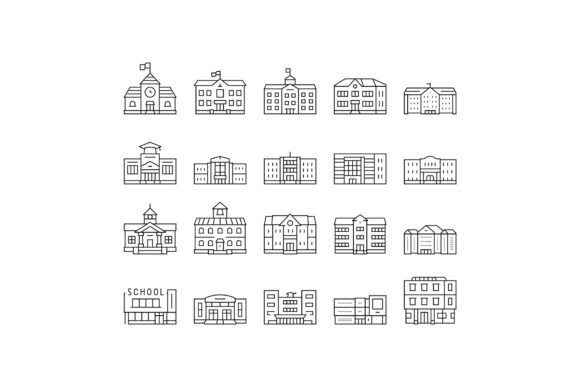
To understand why the Catholic School Line Icon remains a staple in educational design, one must first examine what it represents visually and conceptually. These icons typically deconstruct traditional religious architecture into its most recognizable geometric forms. A "church" icon might focus on the cross, the bell tower, or the arched doorway, while a "monastery" representation often emphasizes cloisters, silence, or communal living structures. Similarly, a "Sunday school" icon frequently combines these architectural cues with symbols of learning, such as desks, globes, or children in silhouette.
The term "Monas" in this context likely refers to the monastery aspect of the icon set, highlighting the historical roots of Catholic education within monastic traditions. By incorporating these elements, the design speaks to a lineage of learning that predates modern secular schooling. This historical weight adds depth to the visual identity of an institution. However, the execution must be precise. A poorly drawn line icon can look generic or even unintentionally humorous, whereas a well-crafted vector illustration conveys dignity and tradition. The strength of the Catholic School Line Icon. Church, Monas approach is its versatility; it can be scaled down for a mobile app notification or blown up for a large banner without losing resolution.
Comparing Line Art with Alternative Illustration Styles
When selecting visual assets for a Catholic school project, designers and administrators often weigh line icons against other styles such as flat color illustrations, realistic photography, or 3D renderings. Each format has distinct tradeoffs regarding cost, scalability, and emotional resonance.
- Line Icons vs. Flat Color: Flat color illustrations tend to be more playful and engaging for younger demographics, such as elementary students. They allow for vibrant palettes that can energize a classroom environment. In contrast, the Catholic School Line Icon style is more subdued and professional. It is often better suited for administrative communications, official documentation, and branding that targets parents and donors who may prefer a tone of seriousness and tradition.
- Line Icons vs. Photography: Realistic photos of actual church buildings or classrooms provide authenticity but lack flexibility. A photo of a specific local church cannot easily represent a global network of schools. Furthermore, photos can date quickly as lighting trends change or buildings are renovated. Vector line icons, however, remain timeless. The abstract nature of the Catholic School Line Icon. Church, Monas allows it to represent the ideal of the institution rather than a specific physical location.
- Line Icons vs. 3D Renderings: Three-dimensional graphics are increasingly popular for their depth and realism, yet they require significant processing power and file size. For a website loading on a slow connection or a printed brochure with tight budget constraints, the lightweight nature of a line icon is a superior choice. It ensures fast load times and crisp printing at any size.
Evaluating Strengths and Tradeoffs in Design Strategy
The decision to utilize the Catholic School Line Icon. Church, Monas style involves weighing several strategic factors. One primary strength is the consistency it brings to a brand ecosystem. Because line icons share a uniform stroke width and style, they create a cohesive visual language when used alongside other elements like typography and logos. This consistency reinforces the idea of unity within the school community, a core value in Catholic education.
However, there are tradeoffs to consider. The minimalist nature of line art can sometimes strip away the warmth and emotional texture found in more detailed artwork. If the goal is to evoke a strong sense of nostalgia or personal connection, a line icon might feel too sterile. It is also crucial to ensure that the specific symbols chosen are culturally appropriate and universally understood within the target demographic. For instance, a stylized monastery icon might resonate deeply with older alumni familiar with the history of the order, but it might confuse a new family unfamiliar with monastic life.
Another limitation is the potential for ambiguity. Without careful design, a simple line drawing of a building could be mistaken for a library or a civic center if the religious markers (like a cross) are too subtle. Therefore, the evaluation process should include testing the icon with a sample audience to ensure the message is received as intended. The Catholic School Line Icon. Church, Monas must strike a balance between simplicity and recognizability.
Best-Fit Situations for Line Icon Usage
Determining when the Catholic School Line Icon is the right choice requires analyzing the specific context of the project. These icons excel in situations requiring clarity, speed of recognition, and adaptability.
- Digital Interfaces and Apps: For school portals, parent communication apps, or student scheduling tools, line icons are indispensable. Their clean lines render perfectly on high-density screens, and their small footprint helps keep interfaces uncluttered. A user navigating a "Sunday School" registration page benefits from an immediate visual cue that confirms they are in the correct section.
- Wayfinding and Signage: Physical signage within a campus often needs to be legible from a distance and in varying light conditions. Line icons, especially when paired with bold typography, offer high contrast and readability. A sign pointing to the "Monastery" or "Chapel" using a simple line graphic is easier to process quickly than a complex image.
- Printed Curriculum and Handouts: Educational materials often undergo multiple rounds of editing and reprinting. Vector-based line icons ensure that the graphics remain sharp regardless of the paper quality or printing method. They are also cost-effective for black-and-white printing, which is common for internal school documents.
- Brand Identity Systems: When establishing a comprehensive visual identity for a diocese or a network of schools, line icons provide a flexible foundation. They can be colored according to specific school colors while maintaining a unified structural style, allowing for both standardization and individual expression.
Decision Factors for Selecting the Right Visual Resource
For adults aged 20–50 tasked with choosing resources for their institution, the selection process should be guided by the specific goals of the communication. If the objective is to convey authority, tradition, and clarity, the Catholic School Line Icon. Church, Monas is a robust option. It aligns well with the values of stability and continuity often associated with Catholic education.
Conversely, if the project aims to highlight the vibrancy of student life, the diversity of the community, or the joy of learning, relying solely on static line icons may be insufficient. In these cases, a hybrid approach might be necessary. Combining line icons for navigation and structure with full-color photography or illustrative scenes for storytelling can provide the best of both worlds. This strategy leverages the functional strengths of the Catholic School Line Icon. Church, Monas while supplementing it with the emotional depth of other media.
It is also important to consider the technical capabilities of the team managing the assets. Line icons are generally easier to edit and customize than complex illustrations. If a school lacks dedicated graphic design staff, having a library of editable vector icons can empower administrative staff to update materials independently. This accessibility reduces costs and increases agility in responding to changing needs.
When to Look Beyond Standard Line Icons
While the Catholic School Line Icon is versatile, it is not a universal solution. There are scenarios where alternative approaches are more effective. For example, marketing campaigns targeting prospective families often benefit from imagery that showcases real people and authentic interactions. A line icon of a "Sunday school" cannot replace the impact of a photograph showing happy children engaged in a lesson. Similarly, fundraising appeals may require more emotive and detailed visuals to inspire generosity.
Additionally, if the target audience includes very young children who rely heavily on visual cues to learn, overly abstract line art might be less effective than colorful, character-driven illustrations. The developmental stage of the audience is a critical decision factor. In these instances, the Catholic School Line Icon. Church, Monas might serve better as a secondary element—perhaps as a logo mark or a footer graphic—rather than the primary visual driver.
Ultimately, the choice depends on a clear understanding of the message being conveyed and the audience receiving it. By carefully evaluating the strengths of line art against the demands of the specific project, educators and administrators can create visual communications that are both aesthetically pleasing and functionally effective. Whether used for wayfinding, digital navigation, or brand consistency, the Catholic School Line Icon. Church, Monas remains a valuable asset in the toolkit of modern Catholic education, provided it is deployed with intention and awareness of its inherent characteristics.