Strategic Value of the Book Character School Icons Set Vector
In the crowded landscape of digital and print media, visual clarity is not merely an aesthetic choice; it is a functional necessity. The Book Character School Icons Set Vector represents more than a collection of illustrations; it serves as a strategic toolkit for professionals aiming to communicate complex educational concepts with immediate recognition. For entrepreneurs, educators, and marketers, leveraging a cohesive set of vector graphics can streamline brand identity, enhance user experience, and reduce cognitive load for audiences ranging from young students to adult learners.
When we examine the components of this specific asset—encompassing study education themes, library environments, children's literature, and student life—we see a unified language of learning. Unlike raster images that degrade upon scaling, vector formats offer infinite scalability without loss of quality. This technical advantage translates directly into operational efficiency. A single file can power a mobile app icon, a billboard advertisement, or a detailed classroom poster, ensuring consistency across every touchpoint. Understanding how to deploy the Book Character School Icons Set Vector requires moving beyond simple decoration and viewing these assets as integral elements of a broader communication strategy.
Defining the Asset: More Than Just Illustrations
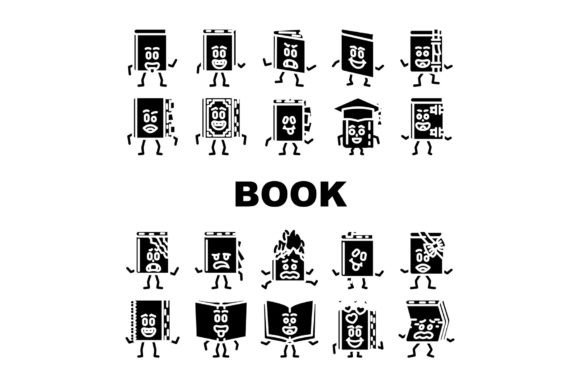
The Book Character School Icons Set Vector typically includes a curated selection of glyph pictograms and character illustrations designed to represent the ecosystem of education. You will find elements such as a girl notebook, open books, school buses, libraries, and various student archetypes. These are not random drawings but semantically loaded symbols. In design theory, a glyph is a visual representation of a concept that transcends language barriers. When you utilize a student book character or a library icon, you are invoking a shared cultural understanding of learning, curiosity, and academic growth.
For decision-makers in publishing or ed-tech, the distinction between a generic clipart image and a professionally designed vector set is critical. Generic assets often lack stylistic cohesion, leading to a fragmented brand appearance. In contrast, a dedicated set like the Book Character School Icons Set Vector ensures that every element shares the same line weight, color palette, and geometric logic. This uniformity builds trust. When a parent or educator encounters a consistent visual language across a website, a curriculum guide, and a marketing flyer, they perceive the organization as professional and reliable. The strategic value lies in this perception of stability and competence.
Operational Efficiency and Scalability
From an operational standpoint, investing in high-quality vector assets reduces long-term production costs. Because vectors are mathematically defined rather than pixel-based, they remain crisp at any resolution. Consider a scenario where a small business owner needs to launch a new literacy campaign. They require assets for social media thumbnails, email headers, printed brochures, and large-format event banners. With a raster image, they would need to commission multiple versions or risk pixelation. With the Book Character School Icons Set Vector, one master file adapts to all requirements instantly.
This flexibility supports agile planning. Marketing teams can pivot quickly without waiting for new graphic design work. If a campaign shifts focus from "summer reading" to "back-to-school preparation," the same character icons can be rearranged, recolored, or recontextualized within hours. This speed allows organizations to respond to market trends or seasonal demands with precision. Furthermore, the inclusion of specific elements like a girl notebook or poster literature themes provides immediate context, reducing the time designers spend searching for appropriate imagery.
Aligning Visuals with Strategic Goals
To maximize the return on investment for any creative asset, it must align with specific organizational goals. Whether the objective is increasing enrollment, boosting book sales, or improving classroom engagement, the Book Character School Icons Set Vector can be tailored to support these outcomes. The key is intentionality. Randomly scattering icons across a page creates visual noise that distracts from the core message. Instead, these assets should be deployed to guide the viewer's eye and reinforce key information.
For instance, if the goal is to promote a new library initiative, using a prominent library icon alongside a welcoming student character can create an inviting atmosphere. This visual cue signals safety and accessibility before a single word is read. In the realm of branding, consistency is paramount. A publisher might use a specific subset of these icons to define their "early learner" series, creating a recognizable shelf presence that parents can identify instantly. Over time, this repetition builds brand equity. The icons become synonymous with quality education, allowing the brand to command a premium position in the marketplace.
Enhancing User Experience and Accessibility
In the digital age, user experience (UX) dictates success. Complex text-heavy interfaces often lead to high bounce rates, particularly among younger audiences or non-native speakers. The Book Character School Icons Set Vector offers a solution by breaking down information into digestible visual chunks. Icons act as signposts, helping users navigate content faster. A study education icon next to a section on homework help immediately tells the user what to expect, reducing friction and improving satisfaction.
Accessibility is another crucial consideration. While icons cannot replace alt-text or screen reader compatibility, they do provide a layer of universal understanding. A well-designed pictogram of a student book character conveys the concept of learning regardless of the user's language proficiency. This inclusivity expands the potential reach of educational materials, making them viable for diverse communities. By integrating these visuals thoughtfully, creators ensure their content is not only seen but understood by a wider demographic.
Navigating Risks and Common Pitfalls
Despite their utility, vector icon sets carry risks if used without a clear strategic framework. The most common pitfall is overuse. Cluttering a design with too many characters and objects can overwhelm the audience, diluting the primary message. It is essential to exercise restraint, selecting only the icons that serve a specific communicative purpose. Every girl notebook or poster literature element included must earn its place on the canvas.
Another risk involves contextual mismatch. An icon set designed for a playful, early-childhood environment may feel out of place in a serious academic journal or a corporate training manual. Before deploying the Book Character School Icons Set Vector, stakeholders must evaluate the tone of their brand and the expectations of their target audience. Using a cartoonish character in a formal setting can undermine credibility. Conversely, using overly sterile glyphs in a children's app can make the product feel cold and unapproachable. Contextual awareness is the bridge between a good design and a great one.
Avoiding Generic Execution
Finally, there is the danger of generic execution. Many organizations download a set of icons and apply them uniformly across all projects without customization. This approach leads to a "template look" that fails to differentiate the brand from competitors. To avoid this, consider customizing the color schemes, combining icons with unique typography, or animating the vector files for digital platforms. The Book Character School Icons Set Vector should be a foundation, not the final product. By adding layers of creativity and specific branding elements, you transform standard assets into a proprietary visual language that resonates deeply with your audience.
Practical Implementation Strategies
Implementing these assets effectively requires a structured approach. Begin by auditing your current visual materials. Identify areas where communication is weak or where visual hierarchy is unclear. Then, map out where the Book Character School Icons Set Vector can fill those gaps. Are you launching a new course? Use a study education icon to highlight key modules. Is there a community event? Use a group of student characters to emphasize participation.
Create a style guide that dictates how these icons are used. Define rules for sizing, spacing, and color usage. This ensures that everyone on the team—from freelance designers to internal marketers—uses the assets consistently. Regularly review the performance of campaigns that utilize these visuals. Do pages with icons have higher engagement? Do users understand the navigation better? Data-driven insights will refine your strategy over time, ensuring that your use of the Book Character School Icons Set Vector continues to deliver measurable results.
Ultimately, the power of these vector illustrations lies in their ability to simplify complexity and humanize data. When used with strategic intent, they become more than just pictures; they become tools for connection, clarity, and growth. By treating the Book Character School Icons Set Vector as a critical component of your overall business plan, you empower your organization to communicate more effectively and achieve its long-term objectives with greater confidence.