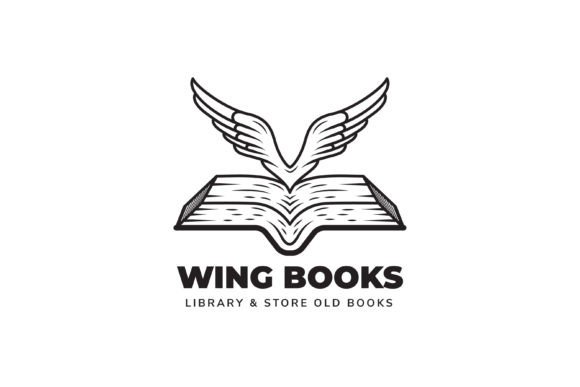
Wing Books Logo: A Retro Line Style Design Evaluation
In the realm of visual identity for educational institutions and literary businesses, the Wing Books Logo presents a distinct aesthetic approach. This design concept merges the traditional symbolism of a book with the dynamic imagery of wings, rendered in a retro line style. Isolated on a white background and utilizing a strict black-and-white color palette, the graphic aims to convey themes of knowledge, freedom, and academic growth. For designers, educators, and bookstore owners evaluating digital assets, understanding the specific utility, technical specifications, and stylistic implications of this logo is essential before integrating it into a broader brand strategy.
Design Concept and Visual Language
The core of the Wing Books Logo lies in its synthesis of two powerful symbols: the open book and the soaring wing. In iconography, the book represents information, study, and literature, while wings suggest elevation, speed, and the boundless nature of learning. By combining these elements into a single emblem, the design communicates that education is not merely about acquiring facts but about empowering individuals to rise above limitations.
Stylistically, the logo adheres to a retro line art tradition. This approach relies on clean, continuous strokes rather than heavy fills or gradients. The monochromatic scheme—strictly black lines on a white field—ensures high contrast and legibility across various media. This minimalism aligns with modern trends favoring simplicity while evoking a sense of classic academic heritage often associated with vintage dictionaries, old college emblems, and historical journals. The result is an abstract yet recognizable symbol suitable for a wide range of educational contexts, from elementary schools to corporate training centers.
Technical Specifications and Usability
When evaluating digital graphic resources, technical flexibility is as critical as visual appeal. The Wing Books Logo is provided in high-resolution formats, specifically at 300dpi, ensuring crisp reproduction in print applications such as brochures, magazine covers, and business cards. More importantly, the asset is fully vector-based. This means the graphics are constructed using mathematical paths rather than pixels, allowing the logo to be scaled infinitely without loss of quality. Whether the design needs to appear on a small social media avatar or a large building sign, the integrity of the line work remains intact.
The file package includes multiple industry-standard formats: AI (Adobe Illustrator), EPS (Encapsulated PostScript), SVG (Scalable Vector Graphics), and JPG. This variety ensures compatibility with different software environments. The editable nature of the text, shapes, and colors within the vector files offers significant customization potential. Users can adjust the thickness of the lines, modify the angle of the wings, or alter the font used for any accompanying typography to better match their existing brand guidelines. The organized structure of the layers further streamlines the editing process, reducing the time required for professional adaptation.
Situations Where the Design Excels
The Wing Books Logo is particularly well-suited for entities seeking to project a balance between tradition and innovation. It serves as a strong fit for several specific scenarios:
- Independent Bookstores and Libraries: Small businesses often need an identity that feels established yet welcoming. The retro aesthetic provides a sense of history, while the wing motif suggests a vibrant, active community of readers.
- Educational Programs and Workshops: Organizations focused on adult education, literacy programs, or specialized study groups can utilize this symbol to represent the transformative power of learning.
- Academic Publications: Journals, magazines, and document headers benefit from the clean, professional look of the line style. It acts as a subtle, non-distracting header or watermark that reinforces the intellectual nature of the content.
- Digital Learning Platforms: The scalability of the vector format makes it ideal for ebook covers, app icons, and website favicons where clarity at small sizes is paramount.
In these contexts, the logo functions effectively as a versatile label or emblem. Its isolation on a white background allows it to integrate seamlessly into complex layouts without clashing with other design elements.
Considerations and Tradeoffs
While the Wing Books Logo offers significant advantages, prospective users should consider certain tradeoffs inherent to this specific style. The primary consideration is the monochromatic constraint. While black and white designs are timeless and cost-effective for printing, they may lack the immediate visual impact of a multi-colored logo in highly saturated digital environments. If a brand relies heavily on specific color psychology to drive recognition, the user will need to invest additional effort into applying their own color palette during the editing phase.
Furthermore, the retro line style, though elegant, carries a specific connotation. It may feel too traditional or "old-fashioned" for brands aiming to project a cutting-edge, futuristic, or purely tech-driven image. A startup focused on artificial intelligence in education might find the vintage aesthetic slightly misaligned with their mission, unless they intend to subvert expectations by blending old-school charm with new technology.
Another factor is the level of customization required. Although the files are editable, achieving a truly unique look may require proficiency with vector editing software like Adobe Illustrator. Users without design experience might struggle to modify the intricate line work without inadvertently distorting the balance of the composition.
Decision-Making Insights
To determine if the Wing Books Logo aligns with your goals, evaluate your brand's current positioning and future trajectory. Ask whether your audience values heritage and classic scholarship over modern flashiness. If your target demographic includes students, librarians, authors, or lifelong learners who appreciate the tactile feel of paper books and the quiet dignity of a library, this design is likely a strong match.
Consider the versatility you require. If you anticipate needing the logo in diverse formats—from embroidered uniforms to embossed letterheads—the vector nature of this asset provides necessary security. However, if your brand identity is strictly defined by a vibrant, multi-hued color scheme that cannot be easily mapped onto a line-art foundation, exploring alternative designs with built-in color complexity might be more efficient.
Ultimately, the value of the Wing Books Logo lies in its adaptability and symbolic clarity. It offers a professional, high-quality foundation for an educational identity, provided the user is prepared to customize it to fit their specific narrative. For those seeking a symbol that honors the past while looking toward the horizon of knowledge, this retro line style design presents a compelling and practical solution.