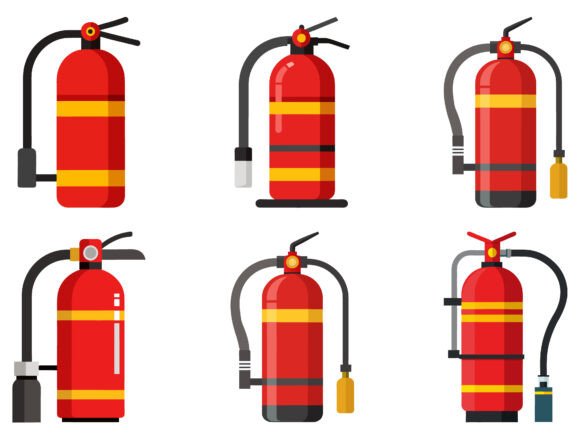
Flat Design Fire Extinguishers – Vector: A Practical Guide for Safety Communication
In the realm of safety communication and instructional design, visual clarity is often as critical as the information itself. Flat Design Fire Extinguishers – Vector graphics have emerged as a standard solution for professionals seeking to convey emergency protocols without visual clutter. Unlike photorealistic imagery or complex 3D renderings, this style strips away unnecessary gradients, shadows, and textures, focusing instead on shape, color, and essential details. For organizations managing workplace safety, educational institutions developing curricula, or designers creating digital interfaces, understanding the specific utility of these assets is vital for effective communication.
The core value of Flat Design Fire Extinguishers – Vector lies in their ability to balance aesthetic modernity with functional precision. By utilizing a minimalist approach, these graphics ensure that the subject—a fire extinguisher—remains instantly recognizable across various mediums, from small mobile screens to large-format wall signage. This article explores the distinct characteristics of this format, compares it with alternative visual styles, and outlines the scenarios where it serves as the optimal choice for safety documentation and branding.
Defining the Distinctive Characteristics of Flat Vector Graphics
To evaluate whether Flat Design Fire Extinguishers – Vector are suitable for a specific project, one must first understand what defines the format. The term "flat design" refers to a two-dimensional graphical style that avoids skeuomorphism—the practice of making digital icons look like real-world objects. In the context of fire safety equipment, this means the extinguisher is represented by clean lines and solid blocks of color rather than metallic reflections or realistic wear and tear.
The "vector" component is equally significant. Vector graphics are created using mathematical equations to define points, lines, and curves, rather than a grid of pixels (raster). This distinction grants Flat Design Fire Extinguishers – Vector infinite scalability. Whether an image needs to be shrunk to fit a website favicon or enlarged to cover a billboard, the edges remain crisp and the details sharp. There is no pixelation or blurring, which is a common failure point when scaling raster images like JPEGs or PNGs.
Furthermore, the color palette associated with these designs is typically intentional and standardized. Dominant red and yellow tones are not merely aesthetic choices; they are psychological triggers associated with fire safety and emergency warnings. Red signifies danger and the presence of fire-fighting equipment, while yellow highlights caution and attention. By adhering to these established color codes within a flat design framework, creators ensure that the graphic communicates its message universally, transcending language barriers.
Comparing Flat Vectors Against Photorealism and Raster Formats
When selecting visual assets for safety materials, decision-makers often weigh Flat Design Fire Extinguishers – Vector against photorealistic photography or high-resolution raster illustrations. Each option carries distinct tradeoffs regarding cost, flexibility, and application.
Photorealistic images offer a high degree of detail, showing the texture of the metal cylinder, the rubber hose, and the specific labeling found on real-world equipment. While this can be beneficial for technical manuals requiring identification of specific valve types, photos often suffer from background noise. A photograph taken in a warehouse may include distracting elements that dilute the focus of a safety poster. Additionally, photos are raster-based, meaning they lose quality when resized significantly. If a single photo must be used for both a social media post and a large banner, the result is often compromised.
In contrast, Flat Design Fire Extinguishers – Vector prioritize abstraction over realism. This abstraction is a strength in instructional contexts. By removing extraneous details, the viewer's eye is directed immediately to the object and its function. For example, in an infographic explaining the PASS technique (Pull, Aim, Squeeze, Sweep), a flat vector illustration allows for clear overlay text and arrows without competing with complex background textures.
Another comparison involves file formats. While raster formats like JPG are ubiquitous, they lack the editability of vector files. With Flat Design Fire Extinguishers – Vector available in AI, EPS, or PDF formats, designers can easily adjust colors to match brand guidelines, resize components, or combine multiple elements into a cohesive layout. Raster images require more advanced manipulation tools to alter colors or remove backgrounds, often resulting in a loss of quality during the process.
Evaluating Strengths and Tradeoffs for Professional Use
The adoption of Flat Design Fire Extinguishers – Vector offers several strategic advantages, particularly for organizations focused on efficiency and consistency. The primary strength is versatility. Because the design is clean and modern, it integrates seamlessly into diverse environments. It looks equally appropriate on a corporate intranet dashboard, a printed employee handbook, or a physical safety sign mounted in a hallway.
High resolution is another inherent benefit. Since vectors are mathematically defined, the concept of "resolution" in the traditional sense does not apply. This ensures that print outputs are always crisp, eliminating the risk of blurry text or jagged edges that can undermine the professionalism of safety materials. For industries where compliance and clarity are paramount, such as construction, manufacturing, or healthcare, this reliability is non-negotiable.
However, there are tradeoffs to consider. The minimalist nature of flat design may not suit every context. If the goal is to train technicians on the specific mechanical operation of a unique or vintage fire suppression system, a flat icon might lack the necessary granularity. In such cases, detailed technical diagrams or photographs are superior. Furthermore, while flat design is generally timeless, it relies heavily on the designer's ability to convey depth and dimension through simple shapes. Poorly executed flat designs can appear too abstract, potentially confusing users who are unfamiliar with the symbol.
Cost and time are also factors. Creating custom vector illustrations requires specialized software and skills, whereas taking a photo can be done quickly with a smartphone. However, for long-term campaigns where the asset will be reused across multiple platforms, the initial investment in a high-quality vector set often yields a better return on investment due to its adaptability.
Ideal Scenarios for Implementation
Determining when Flat Design Fire Extinguishers – Vector are the right choice depends largely on the intended audience and medium. These assets are exceptionally well-suited for educational materials and training guides. In school settings or adult education workshops, the clean lines and bright colors help maintain engagement and reduce cognitive load. Children and adults alike can quickly grasp the concept of fire safety when presented with uncluttered visuals.
They are also ideal for digital and web applications. Modern websites and mobile apps demand lightweight, fast-loading graphics that scale perfectly across different screen densities. A vector-based extinguisher icon ensures that a safety app remains responsive and visually consistent on everything from a smartwatch to a tablet. Similarly, for infographics and professional presentations, these graphics provide a polished look that aligns with contemporary design trends, enhancing the credibility of the presenter.
Merchandise and branding represent another strong use case. Organizations often distribute branded merchandise like t-shirts, stickers, or brochures to promote safety culture. Flat Design Fire Extinguishers – Vector translate beautifully onto fabric and packaging because they do not rely on fine gradients that might fade or blur during the printing process. The bold red and yellow tones pop effectively on various backgrounds, ensuring the safety message remains visible.
Decision Factors and Alternative Approaches
Before committing to Flat Design Fire Extinguishers – Vector, stakeholders should evaluate their specific requirements. If the project demands extreme realism for legal or technical identification purposes, alternatives such as 3D renders or high-definition photography may be more appropriate. Similarly, if the target audience consists primarily of individuals with low visual literacy or those who require highly detailed step-by-step mechanical instructions, a combination of flat icons and annotated photographs might be the best hybrid approach.
File availability is also a practical consideration. While vector formats like AI, EPS, and PDF offer maximum flexibility, some end-users may only need raster versions like JPG for quick web deployment. Fortunately, many resources provide both, allowing teams to select the format that best fits their workflow. Ensuring that the chosen asset supports the necessary output method—whether it is a laser printer, a vinyl cutter, or a web browser—is crucial for avoiding last-minute conversion issues.
Ultimately, the decision rests on the balance between aesthetic goals and functional needs. Flat Design Fire Extinguishers – Vector excel in scenarios requiring clarity, scalability, and broad applicability. They are a robust tool for anyone tasked with communicating fire safety protocols in a modern, professional manner. By understanding their strengths and limitations, organizations can leverage these graphics to create impactful, enduring safety communications that resonate with their audience.